I had a plan for October and to do that, I needed some experience in paddling a sea kayak. I think at this point, I didn’t really know what a sea kayak was. But I knew it would involve wearing a spraydeck.
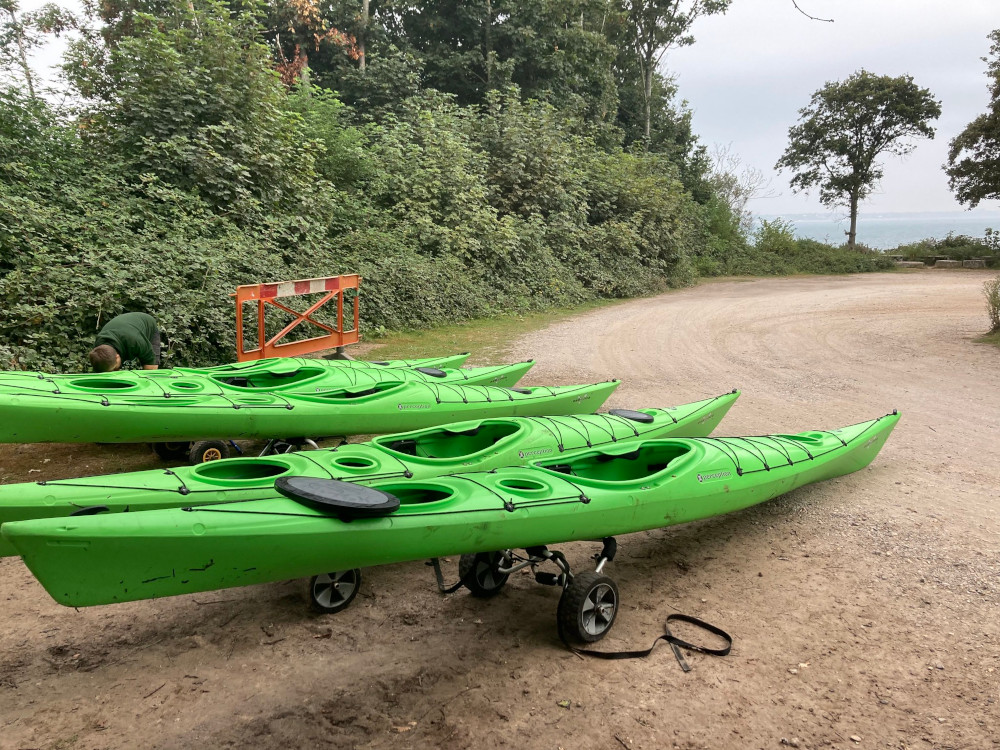
The sea kayak in question was seventeen feet long – half the length again of my car. I tried to imagine it strapped to the roof. The sit-on-tops are kept down at the beach hut but the sea kayaks are kept up on top of the cliff at HQ so once we were all dressed up, spraydecks and all, the first job was to put the boats on wheels and pull them down the access road to the slipway. Then we had to get them set up. Closed kayaks have footrests inside which need to be adjusted to the paddlers leg length, and then we had to practice putting the spraydecks on and pulling them off. You need to be able to do this with your eyes closed because when you’re upside down underwater, you can’t necessarily see what you’re doing. Find the edge, follow it round, grab the loop and pull. Our nylon non-stretchy decks were likely to open automatically under the pull of gravity but you have to know what to do in case they don’t. I was surprised but very relieved to learn that Elliott, our guide, had no plans to make us practise capsizing. As long as we knew the theory in case anything went wrong, the plan was to stay upright.
The long – so long! – narrow boat felt very unstable compared to the wider sit-on-tops and the spraydeck felt confining. It was designed to hold me upside down if anything tipped the boat over and keep the water out so the kayak didn’t flood. I wouldn’t just fall out. I’d stay attached to the kayak, upside down. In theory, I could then very easily roll or be rolled upright without the hassle of emptying the boat and getting back in. That’s what I was nervous about, capsizing and ending up hanging upside down underwater. But I was surprised how quickly I started to feel comfortable in this great green arrow. It cut through the waves as if it was designed to handle the open sea and I found myself leaning into the waves in a way I couldn’t have done a couple of years ago. Maybe even a couple of months ago.
This being an introduction to sea kayaking, once we were away, Elliott started introducing technique. How to turn a kayak designed to forge forwards through waves and swell. Sweep strokes. Stuff I was pleased to discover I’d already done on my Discover/Explore weekend, albeit in a very different, more manoeuvrable boat. A less wobbly one!
We wobbled along the coast to Old Harry where Elliott peeked through to make an educated decision whether to go through or not. He reported that the sea was “a bit fruity” which made him inclined to stay in the sheltered bay. At that point, the earlier sit-on-top group returned. The narrow gap makes a bottleneck and the water is rough, if shallow, through there. The SOTs immediately started capsizing. Their guide rescued them and Elliott lingered in case he was needed. My leader’s instincts promptly rose up and were quashed. No. You’re unqualified and pretty inexperienced, in a new and scary kayak. If you go to help, you’ll just end up in need of rescue too and that makes it worse for everyone.
Once the other group was clear, we slowly followed them back. I definitely felt a little less wobbly. Elliott took us to the sheltered corner of the bay where those of us who wanted to try capsizing could. Next stop would be the slipway so we wouldn’t have time to get too cold.
I declined. Of course I should have tried it. It was warm and I’d only just evaded capsize practise on my training weekend. But I don’t like cold water. I don’t like being underwater. And I don’t like being suspended upside down underwater. I’d sea kayaked. I’d worn a spraydeck and that in itself was a step forward. I knew how to escape. I could paddle this huge boat. I was ready for my big adventure.
 Bumblebee Paddles