And at last we come to the end of my paddling story! I don’t know what date this will end up being published because I’m writing it before we reopen the boat club for the season, so there might be stuff about boat club and my 2024 paddling and this might not end up where it’s currently supposed to, which is August 15th. I started this blog in January 2024 and the last thing left to catch up on from before that is the PSR training day. I have no idea what I’m going to write from now on. I guess we’ll see how far my imagination can stretch and what I can find to say about paddling in the abstract.
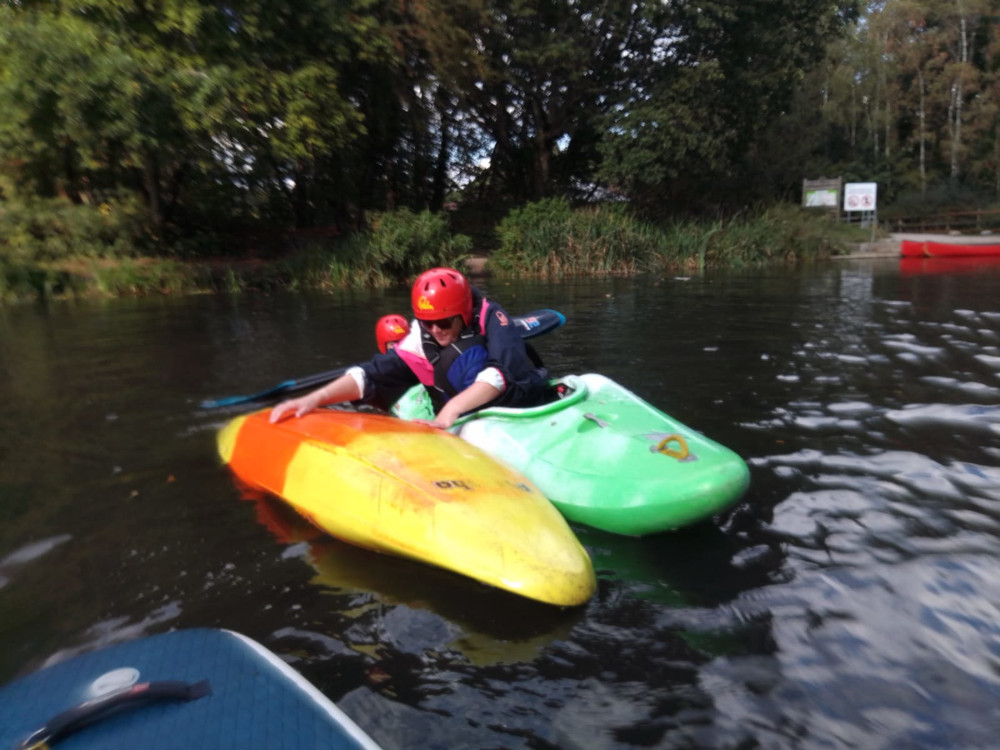
So, it’s October 2023 and I’m at the Basingstoke Canal, somewhere down the back of what I thought was a tiny private military airfield and which turns out to actually be quite a big place – Farnborough Airport, which I think is mixed military and expensive private civilian. But that’s besides the point.
I had trouble with finding a PRS course. That’s partly because I wasn’t sure I was actually ready for this, partly because there wasn’t anything local outside of proper freezing winter and partly because the ones that looked promising and a bit warmer required you to bring all your own safety kit. Today, I could probably borrow it from the boathouse but at the time, I didn’t feel like I was quite ready to request the use of some stuff that I wasn’t entirely sure we actually had. Buying it myself would come to around £200. As it happens, I’ve built up a reasonable collection of my own safety stuff since then but I still don’t have everything the courses required. And it’s partly because many of the courses expected you to provide your own craft. I don’t have my own kayak. I will probably never have my own kayak. Maybe I could borrow the Jive from the boathouse but I don’t have a roofrack and I’d never be able to hoist it up on top of my car on my own, anyway. Even for this course, which didn’t require the kit, and was in October, I had to email and check that I could borrow a kayak before making the booking.
So there we were. There were three of us. I had half an idea of becoming an instructor for the boat club, there was a boy who was going to become an instructor at an outdoors centre, the kind where the kids have to be trained in just about every outdoor activity in existence, and a woman of about my age who had some idea of leading SUP expeditions up a local river for her local school. Yes, they were both on paddleboards and I was the only kayaker. That means it’s hard to tell whether I’m really bad at the various things we did or whether it really is harder in a kayak.
The first part of the day was all theory. We sat outside, with a trailer of canoes as our classroom wall and a whiteboard hung from it, as we went through hazards and risks and water. As a sea kayaker, my hazards and things I have to be aware of are a bit different to the rivers and sheltered water that my fellow students were thinking of. Other moored and moving craft, wildlife, waterborne disease, things underwater and so on, those are applicable to all of them. I probably don’t have to worry about weirs, though, and they don’t have to worry about tides, cross-Channel ferries, tourists on jet skis, sandbanks at low tide etc. After hazards came rescue, and the concept of least risk to most. That means your preferred way of rescuing someone is talking to them rather than getting hands-on. The rest of the group take priority over the rescuee at this point because you don’t want to create a second casualty. Try to get the casualty to rescue themself, use the equipment, use the kayaks and the paddles and the buoyancy aids and only as a last resort do you actually get involved yourself. A panicking casualty can easily capsize you. So talk, reach, throw, row, go.
At this point, we got onto a little detail that I hadn’t heard. British Canoeing – now Paddle UK – issued guidance that SUP leashes should be on quick-release waist belts rather than velcroed around your ankle in the traditional way, because ankle leashes are really hard to reach and undo in an emergency situation. So I now have a waist belt which my existing leash is attached to. Last, we got onto clothing. Buoyancy aid and something on your feet at all time as a bare minimum. Wetsuits are good, obviously, but even a t-shirt and shorts is preferable, from a professional point of view, than SUPing in a bikini.
Then we got dressed and went over to the canal to practice towing. That meant taking three paddleboards, three kayaks and two canoes across a country track, through the riverside car park and putting them all on the water. I thought I was all good on towing. I’d learned the contact tow on my Sea Kayak Award training weekend, used it all summer at the boathouse and had tried out being on both ends of a towline. But what our instructor wanted was for us to find various ways of propelling each other’s crafts around without any ropes or slings first, so gently bashing them towards the bank, having them hold on in various ways and when we did get to including equipment, I discovered that what we really wanted was some way that you can quickly release yourself from. With the towlines I’d used previously, they’re on quick-release belts but when you’re using a length of sling, it’s not optimal to clip it onto anything or to wear it round your waist or tie it.
After lunch, we went out to do actual rescues, the bit of the day described in the pre-event email as “very wet”. For your PSR, you have to be able to rescue any craft from your own craft. Back when it was FSRT, Foundation Safety & Rescue Training, you had to be able to rescue any craft from any craft. I do see why that is but we literally will never take a SUP out at the boathouse. I admit, we do have a canoe.
This was the bit where I kind of started to resent my kayak. The two on the SUPs could sit sideways on them, kneel on them, lean back on them etc. I can’t do that confined to a kayak. I can barely turn far enough that I can make use of the arm that’s furthest away from the rescue. Getting a casualty onto a SUP from a SUP is easy enough. Even I can do that. Getting a casualty onto a SUP from a kayak means an awkward scramble out of said kayak and onto the the SUP, which I think isn’t really ideal because you’re likely to lose your kayak and your best method of propulsion. On the other hand, I’m talking about an unconscious casualty here and to be not-drowned across a SUP floating freely and waiting for pickup by the RNLI is better than drowning.
The various kayak rescues from a kayak are even worse. Draining a kayak by pulling it across my deck is incredibly hard, even with my casualty conscious and able to help. But Hand of God is absolutely beyond me. The best way to deal with an unconscious casualty is to flip their kayak up the right way and tow them to shore while they loll helplessly but upright. Far easier than getting them out of the kayak, onto your kayak and then back to shore. But I can’t do it. One, as I mentioned, I can’t reach across with the furthest arm to get hold of the kayak. Second, you’re supposed to push the bottom down, pull the top up and flip it over. I can’t get any grip on the kayak. I’d need to be wearing the gloves from Mission Impossible: Ghost Protocol to get enough purchase on slippery wet plastic to actually turn it over. Even trying the “nuclear option” where I leap out of my kayak and use my weight to pull it over didn’t quite work. Nearly, but not quite.
And last, the canoe. If your casualty is trapped, get them to hang on underneath while you flip it and them up the right way. If they’re not responsive, you tip it slightly to peek underneath which is often enough for the casualty to float free and you can then rescue them using whatever craft you’ve got, leaving the canoe itself to be dealt with later. But the last bit is to drain the canoe, right it and get your casualty back in it, if they’re in a fit state. I mean, simple capsizes do happen – casualty doesn’t always mean injured and unable to go on. But have you ever tried to haul an upside-down canoe across a kayak? They weigh a ton!
The best I can say for the day is that our instructor made a point that “this is a training course, not an assessment course”. Had there been any element of assessment, I’d have failed. A part of me is kind of miserable that it went so badly but another part of me is trying to remind myself that it’s training. I’ve never done this before. You’ve got to start somewhere. You’re not going to be brilliant at everything first time. Perhaps by the time this is published, I’ll have had some more rescue practice and maybe even redone my PRS with our local pet instructor from the boathouse.
I’d had some ideas that the Instructor course would be easier than PSR. This is the important safety prerequisite, Instructor will just be about teaching and running sessions. Much better. Nope. The Instructor course is assessed throughout the two days and it includes three rescues, which are timed. If you can’t do the three rescues within the time limit, you’re not passing. So I put any idea of doing Instructor any time soon out of my mind.
 Bumblebee Paddles