I don’t usually write about things as they’re happening but boat club two weeks ago got cancelled and that threw my blog schedule out, so I’m writing about my Paddlesport Leader training course halfway through it, on Wednesday evening.
I emailed Paul, the instructor, several months back to ask if this was suitable for my current ability level and what I want to do – ie be able to run the boathouse sessions when Butterfly can’t make it. The trouble is figuring out what qualifications I actually need, what with Paddle UK cresting about 300 new ones and Girlguiding updating its adventurous activity requirements. Paddlesport Leader seems more basic and easier to achieve than Instructor or Coach but it also appears to be a standalone – once you’ve got it, off you go. Maybe we’ll sort that question out tomorrow.
Anyway, even if it’s not the right qualification for the boathouse, it never hurts to have more training and more experience, especially in leading a group. So I booked it.
Contrary to the picture below, there were six of us training this afternoon, although only five in the morning. In the afternoon, Paul swapped his kayak for a SUP and one of the group swapped for a canoe, so we had three different crafts to play with.
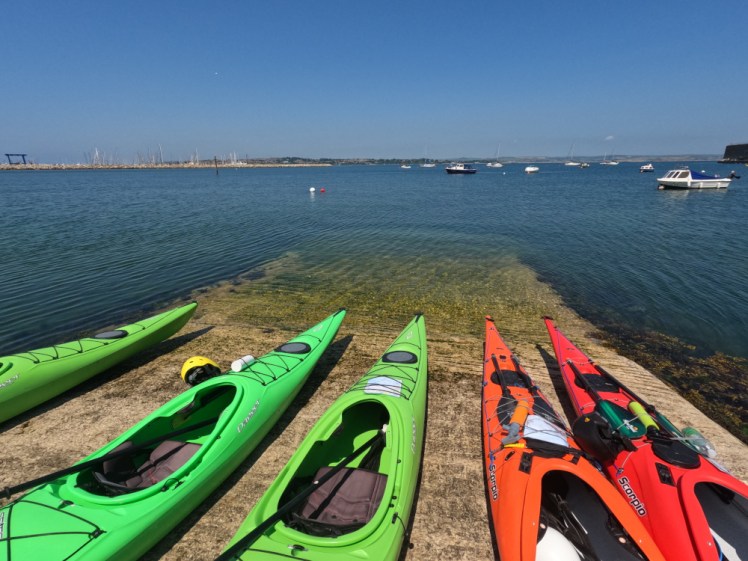
We were all in different situations. One was using it as a last-minute refresher before his Sea Kayak Leader assessment tomorrow. One was using it as the nearest equivalent for starting up a gig rowing business, which apparently doesn’t have anything like this training and qualification. We had a PGL instructor who I think was looking to level up a bit, although he took me by surprise with his competence and professionalism, because that’s kind of not really what I thought PGL instructors were like. Another just thought it would be good to get into after volunteering as a guinea pig for other people’s assessments.
We started, as we so often do at this kind of thing, with land-based theory – look at the kit, look at what we’re wearing, look at the boats, find out about the group and their existing paddle experience, other relevant skills and so on and then take to the water.
This is where Paddlesport Leader deviates hugely from what I’m already doing. We did some paddling around and some games to assess our pre-existing abilities. I would not do this with a group I’m leading because they’ll be Guides, girls aged 10-14 (and the occasional Ranger group, 14-18) who’ve mostly never kayaked before. Job one isn’t to see whether they can go forwards, backwards and turn. Job one is to see who freaks out – and it happens regularly. Job two is to see whether they can figure out how to paddle. Job three is for someone to help the girl in every group who just goes round and round in circles. Games as training in disguise happens towards the end of the session, not the beginning.
We paddled around the harbour, doing some group management and positioning – going round blind corners to show how the leader should handle that sort of thing, getting is yto play leader for small groups and navigation, finding our position on a map and explaining how we figured that out. The Castle is a great landmark for that.
Then we paddled up into the marina, taking it in turns to lead, while Paul threw in incidents, like stopping to fix a slipped footrest, a lost paddle and then a head injury going under a bridge, which brought in contact tows.
With all that done, we went ashore for lunch and to pick up our sixth member. More theory ensued, including CLAP, which I remember covering in PSR training. Communication, line of sight, awareness/avoidance and positioning, although since everything really comes from awareness, it probably should be ACLP. We went over each of these points, put on more sun cream and set off.
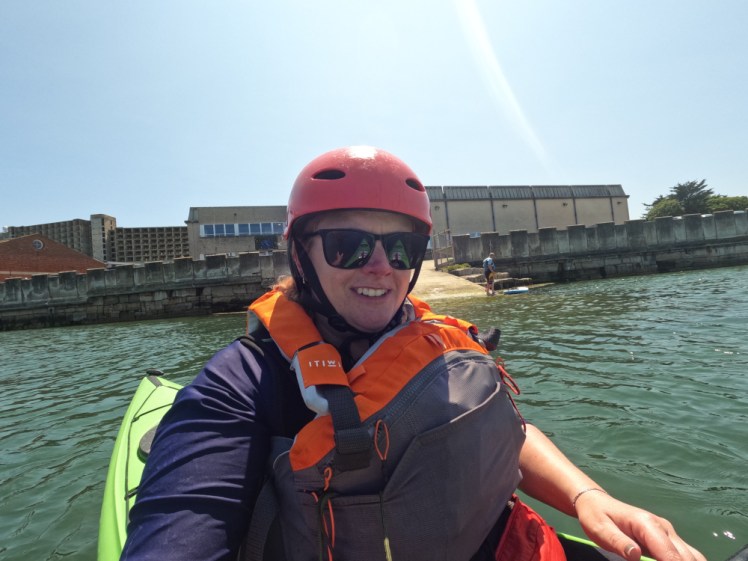
We “incident hiked” our way through the marina, taking it in turns to lead and learn about peculiarities of SUPs and canoes (in particular, getting SUPists down on their knees whenever a hazard hoves into view) and out the other side, towards the shallows where we practised some rescues. Rescuing each other, then rescuing the SUP and canoe from our kayaks if we were looking at the multicraft Paddlesport Leader, then some self rescue.
Let’s cut that sorry story short by saying this is my Achilles heel and it’s a very big foot. One option for getting round it is that I decide it’s not my job, as the newest and least experienced member of the boathouse, to become the second instructor, and that’s the one I was tempted to make right then on the spot as I clung helplessly and furiously onto the side of my kayak.
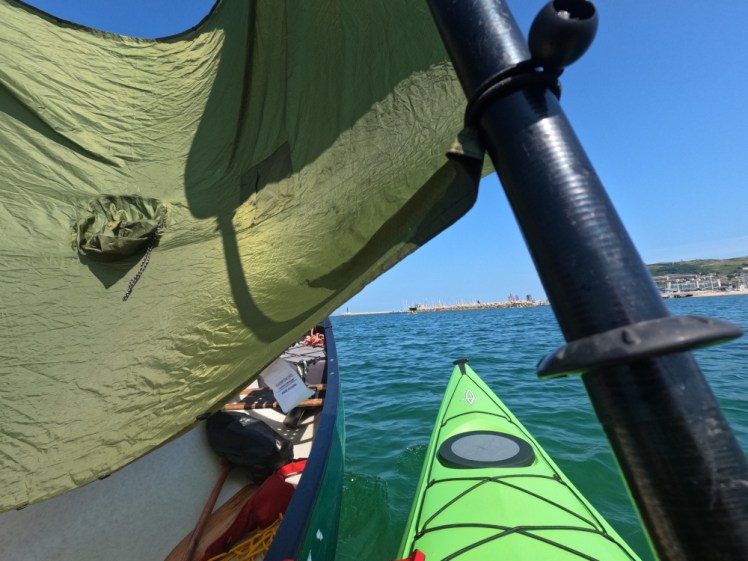
After that, we grouped up again and improvised a sail. Well, Paul had brought the rain ponchos with toggles for the specific purpose, we weren’t turning our own clothes into an actual improvised sail. I’ve never kayak-sailed before or ever wanted to. I’m no sailor – I hate the way dinghies lean as if they’re trying to tip you out but also I simply do not understand the physics of wind and sails. Luckily, Mr PGL is also a dinghy instructor. We rafted up, using his and my slings and quick-release knots to tie his canoe and our kayaks together, turned our paddles into masts and sailed very slowly, with virtually no wind and a very heavy “trimaran” towards the harbour wall.
There we derigged and became paddlecraft again to paddle home. Paul demonstrated using the canoe to rescue a tired paddler, so we took it in turns to tow the SUP back and the last bit was some rescue of “unconscious” paddlers in the water using the various craft and other nearby paddlers. And then we were done!
I remember being an exhausted wreck after my Discover training day so I was prepared to be dented and battered. But other than my failed attempts at self-rescue, the paddling was relatively sedate – it was very windy on my Discover weekend and we had a lot of pretty open and exposed water to cross before we could do anything, or before we could go home. Or maybe I’ve just got better at paddling in the last four years.
Anyway, by the time this is published tomorrow, Thursday, I’ll have finished the course but this time I’ve got a whole week to write it up, so I’ll tell you all about it next week. Fingers crossed it goes ok.
 Bumblebee Paddles